
Thoughts on "Change"
Introduction
What follows is a quasi-book report on Damon Centola’s non-fiction sociology book, Change: How to Make Big Things Happen. According to his bio page at the Annenberg School of Communication at the University of Pennsylvania, Centola is:
“…the Elihu Katz Professor of Communication, Sociology and Engineering at the University of Pennsylvania, where he is Director of the Network Dynamics Group and Senior Fellow at the Leonard Davis Institute of Health Economics. Damon’s research centers on social networks and behavior change.”
The book focuses primarily on the science of social influence and how information moves from one person to another across connected networks. Centola repeatedly compares the spread of ideas to the spread of viruses, but explicitly notes that this metaphor only works for what he considers “simple contagions” and can severely backfire if the goal is to actually change social norms. For “complex contagions”, simple virality is ineffective and should be replaced with a very different strategy. Change contains a number of critical ideas regarding the nature of social influence, including:
Clear differentiation between “simple” and “complex contagions”;
The key characteristics of different types of social networks, most notably “fishnet” vs. “fireworks” patterned social connections among large groups of people;
Clear differentiation between “wide” and “narrow” bridges between different groups of people;
Specific strategies for influencing large groups of people; and
Why “influencer-marketing” often fails to work for people engaging in a social change mission.
Each of these themes is worth exploring, and Centola does offer a few insightful observations that can be applied to our work at Return on Ideas, but I believe the book can be almost entirely summed up in two words: Peer Pressure.
Simple vs. Complex Contagions
Simple Contagions are pieces of information, content, or basic ideas that spread memetically. News of an impending tornado or hurricane; celebrity gossip; a new movie trailer or album release; results of a presidential election; and so on are all examples of simple contagions. These are ideas that do not require the recipient to significantly alter their worldview or change their opinions about the nature of reality. It’s just information, with which the end user can do what they will.
Simple Contagions can spread quickly and easily across narrow bridges and fireworks-pattern influencer networks because there’s little to no resistance in adoption and because the end goal is typically just “awareness”. Even where there is a concrete call-to-action, such as “buy a ticket for Aquaman 2”, the idea being spread is very basic and does not risk setting off anyone’s ideological immune systems.
By contrast, Complex Contagions involve the spread of ideas that require the adopter to revise their core beliefs or identity and/or to endure significant economic or social risks, and thus which are actively resisted. These include things like changing political ideologies, participation in riots or revolutions, adopting different lifestyle trends (eg. clothing & hairstyles, aesthetic preferences, sexual / gender identities, etc.).
Per both “Change” and his paper, “Complex Contagion and the Weakness of Long Ties” (via Wikipedia), Centola identifies four different mechanisms for the transmission of complex contagions, each of which demonstrates why multiple exposures to the same new idea is necessary for widespread adoption:
Quote:
“Coordination — Certain innovations become attractive only when people collectively adopt them. In his book "Change," Centola discusses that social technologies like popular media-sharing platforms such as Twitter and Facebook only become valuable once a critical mass of individuals within your social network begins to use them. Many innovations are costly, especially for early adopters but less so for those who wait. The same holds for participation in collective action.
Credibility — Innovations often lack credibility until adopted by neighbors. Hearing the same story from different people makes it seem less likely that surprising information is nothing more than the fanciful invention of the informant.
Legitimacy — Knowing that a movement exists or that a collective action will take place is rarely sufficient to induce bystanders to join in. Having several close friends participate in an event often greatly increases an individual’s likelihood of also joining, especially for high-risk social movements. Innovators risk being shunned as deviants until there is a critical mass of early adopters, and non-adopters are likely to challenge the legitimacy of the innovation.
Emotional contagion — Most theoretical models of collective behavior – from action theory to threshold models to cybernetics share the basic assumption that there are expressive and symbolic impulses in human behavior that can be communicated and amplified in spatially and socially concentrated gatherings.”
The important takeaway here is that anyone who is attempting to seriously change the culture must find a way to not only create effective (and “sticky”) messaging, but also to find ways of getting those messages reinforced numerous times through credible vectors (as judged by the recipient of the message).
Standard marketing theory suggests that most people will need to hear a message multiple times (in some cases 20+) before they commit to a buying decision and become customers. As the Red Crow agency put it:
“The first 4 times you see an advertisement, you hardly notice it – it’s just entering your radar.
The fifth time you see it, you finally read it.
The 6th – 8th times it appears, it starts to annoy you.
By the 9th time, you start to wonder if there’s maybe something to it.
Views 10, 11, and 12 prompts you to casually think about it. Maybe you ask a friend about it or do a quick scan through their website, and the rest is history.
By the 13th time you see an advertisement, the product or service is worth something.
In views 14-19 you slowly convince yourself to make a purchase and start saving for it.
By the 20th time you see the same advertisement, sold.”
But this advice normally assumes that there’s minimal resistance to product adoption and that the “buying decision” doesn’t conflict with a person’s core values or identity, which is emphatically not how social change works. Reinforcement is critical, but for it to be effective in a social change context, it must take place within the right kinds of networks, and the message must be presented by credible influencers who have strong ties to the community that needs to be reached.
Those ties are crucial.
Networks & Bridges
Fireworks & Narrow Ties
Centola talks extensively about the importance of different network structures, and the kinds of relationships that people have with each other within those networks as well as the bridges that connect one group of people to another. “Narrow” bridges between individuals and groups are weak, sometimes isolated ties such as those between acquaintances or where only one or two people within one community ever interact with one or two people from another community.
One example Centola provides of narrow bridges would be in the corporate world where one person on one team (eg. sales) is the designated liaison to one person on another team (eg. engineering). With only one comparatively weak tie between the two teams, simple contagions — basic information — can be easily and efficiently shared between the two networks, but not norms and values.
“Silos emerge when there are no bridges between groups, preventing valuable information from traveling between them.”
— Damon Centola
Alternatively, if the individuals on both teams all know each other and maintain close friendships, Centola would call that a “wide bridge” between the two groups. The nature of those stronger connections means that in addition to “simple contagions” spreading across the total population, “complex contagions” such as shifting social norms and business processes can take place.
For example, the standard influencer-marketing strategy relies on what he calls a “Fireworks” patterned network. This is a network with one hugely influential person at the center of a large number of “narrow” bridges to their fans.
That looks like this:

The Fireworks network works really well for spreading simple contagions because 1) the influencer can reach a very large number of people at once; and 2) there’s very little friction or resistance to the new information.
Imagine Taylor Swift telling her millions of adoring fans that a new album is about to drop.
This information is obviously relevant to the network and nobody within her network has a political or identitarian reason to reject it or challenge its accuracy because… well… they’re Swifties. They already trust and respect the influencer and they will be excited to learn about the new album.
By contrast, Taylor Swift broadcasting a political message is not likely to compel anyone to change their core convictions. To the contrary, entertainers / influencers who do this may accomplish nothing other than alienating a large subset of their fans and potentially push them to circle their tribal wagons and become more entrenched in their oppositional ideology.
Centola notes that it can also be very difficult to even convince hugely successful influencers to promote “complex contagions” such as minority political viewpoints or untested commercial products because doing so carries significant reputational risks. We’ve all seen numerous celebrities enrage potential fans and ticket-buyers by making political statements on both the right (eg. James Woods, Adam Baldwin) and the left (eg. Sean Penn, Rachel Zegler, Brie Larson, Matt Damon, and virtually everyone else).
Likewise, it’s understandably expensive to convince a major influencer to share an untested product such as a non-Apple / Samsung phone, because their reputations hinge on recommending stuff their network will love. What if the phone turns out to be a brick? What if other influencers or celebrities won’t endorse it?
And worst of all: What if, in spite of the influencer endorsement, the network doesn’t buy the product? In that scenario, the influencer is associated with a flop and her inability to convince her audience to become customers will reduce her value to other advertisers.
For these and other reasons, Centola describes this as the “Myth of the Influencer”.
So… What does he recommend instead?
Fishnets & Wide Bridges
Going back to the two words we started with, most people are most strongly influenced by their direct network of family, close friends, and other trusted associates. Unlike the “Fireworks” pattern networks we see with influencers, normal human relationships tend to look more like a “Fishnet”, where there are multiple overlapping connections.

This is obviously a simplistic visualization, but it conforms to how most of us actually experience life. People are interconnected.
But given that Centola’s argument is that for “complex contagions” to spread, those messages need to be reinforced multiple times. So the inherent redundancy of the Fishnet network structure means that with a few carefully placed agents, you can start changing norms and philosophies as long as you can overcome resistance within the population.
I’ve tried to visualize that process by imagining competing policy organizations — blue, red, and yellow — all vying for influence within a particular network (eg. a single town). Let’s say each organization manages to entice a few people to promote their cause, but each takes a slightly different approach. Let’s say the blue organization finds three evangelists to promote their worldview, and each of those people are close, but not directly adjacent, to each other in the network.
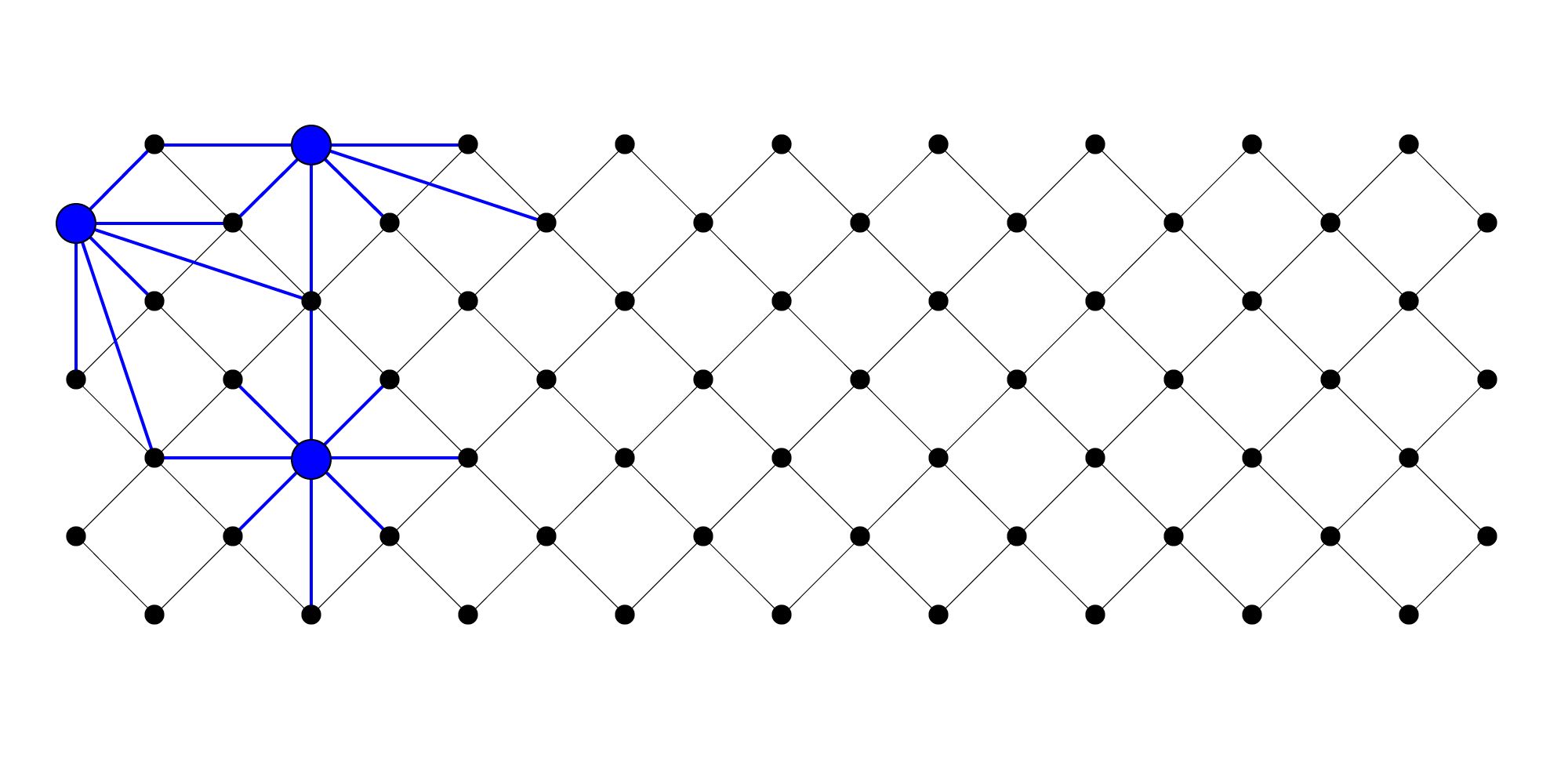
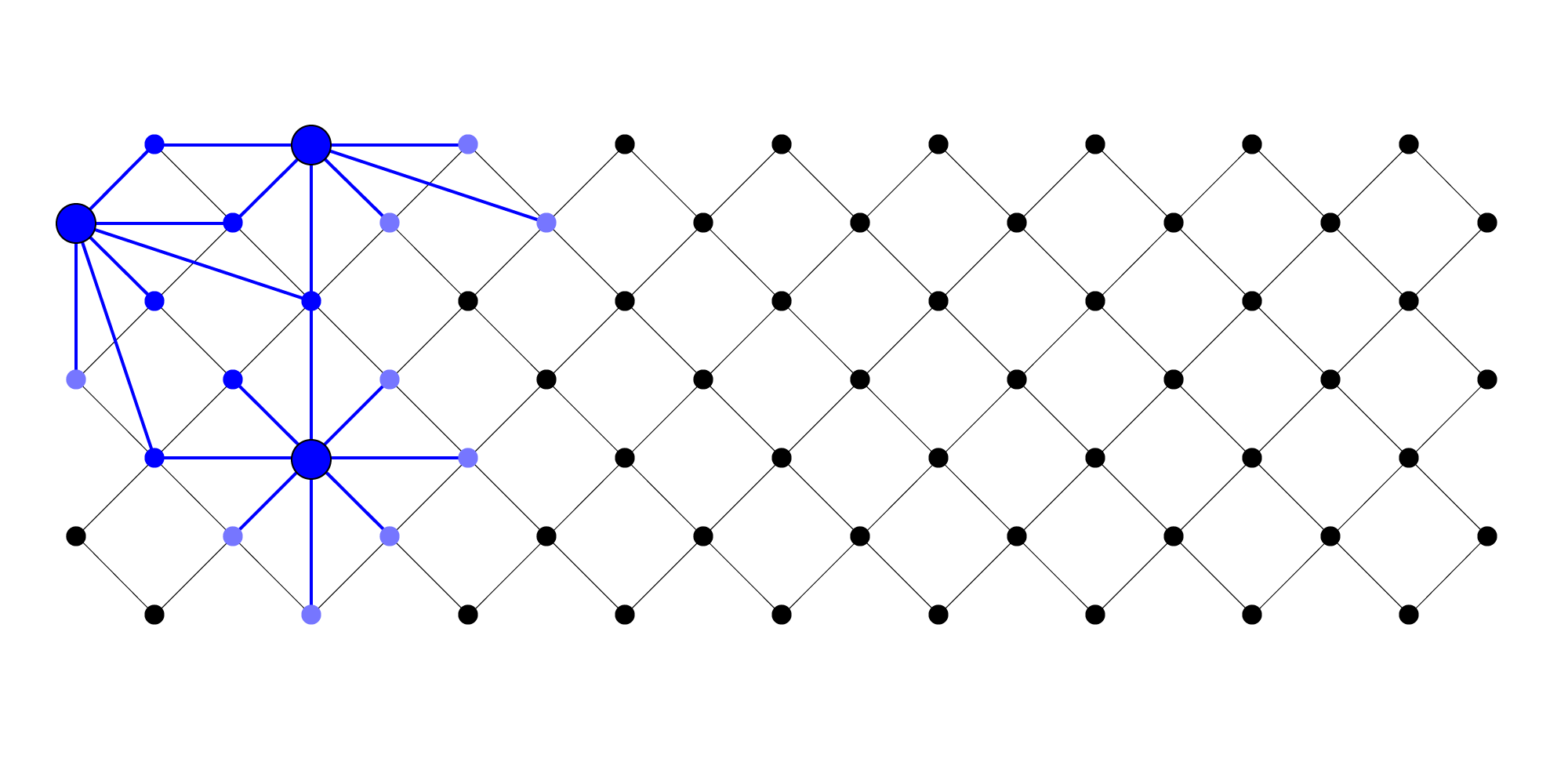
As you can see, there are several contacts shared between each of the three evangelists, such that it’s likely for multiple people within that part of the network to experience redundant messaging from trusted peers. As a result, a few of the people influenced are going to get strong reinforcement from their community to support the blue organization’s ideas.
Even those who don’t experience redundant messaging from the evangelists is surrounded by other “blue” people and will be influenced to some degree, as long as there aren’t a lot of countervailing influences nearby.
Now let’s imagine that the red organization has some evangelists of their own, one of which is fairly close to the edge of the blue organization’s influence, but the other two are at somewhat isolated points in other regions of the network:
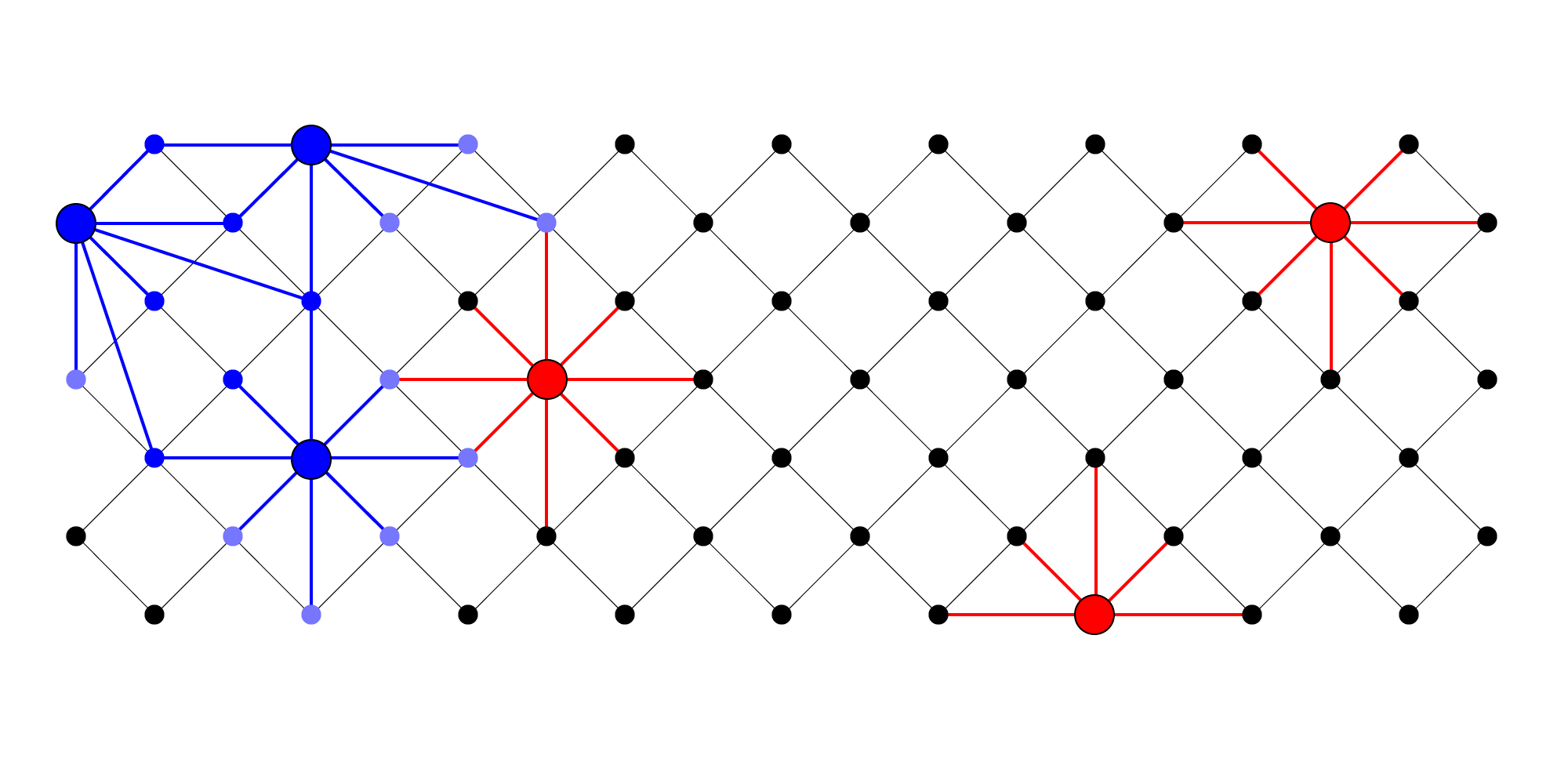
In this case, the isolated evangelists can have a bit of direct influence where they are, but there’s no overlapping redundancy so few of the people influenced will get the reinforcement they likely need to radically change their views.
And in the case of the evangelist nearest the blue organization’s realm of influence will act as a countervailing influence on just a few of the blue people (turning them purple):
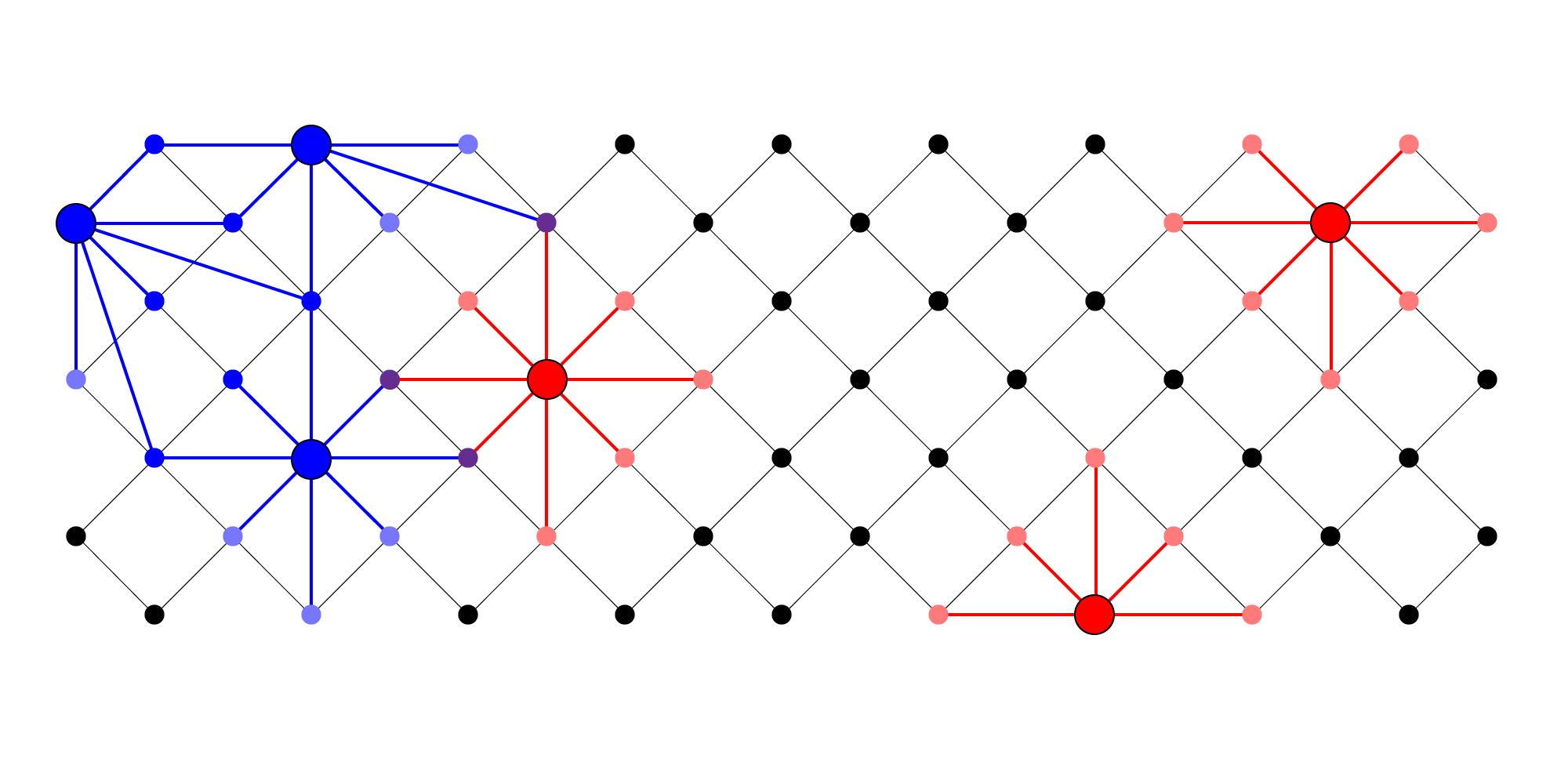
Lastly, let’s add a smaller yellow organization trying to influence this microcosm of society to a 3rd ideological position, but they can only convince one evangelist to represent their views in this network. If that organization wants to be effective, given its limited resources, the ideal evangelist would be positioned within the network in a place that doesn’t have a lot of competing influencers.
But even if it’s butting up against, for instance, the red organization’s more isolated evangelists, the yellow organization could still make a difference.
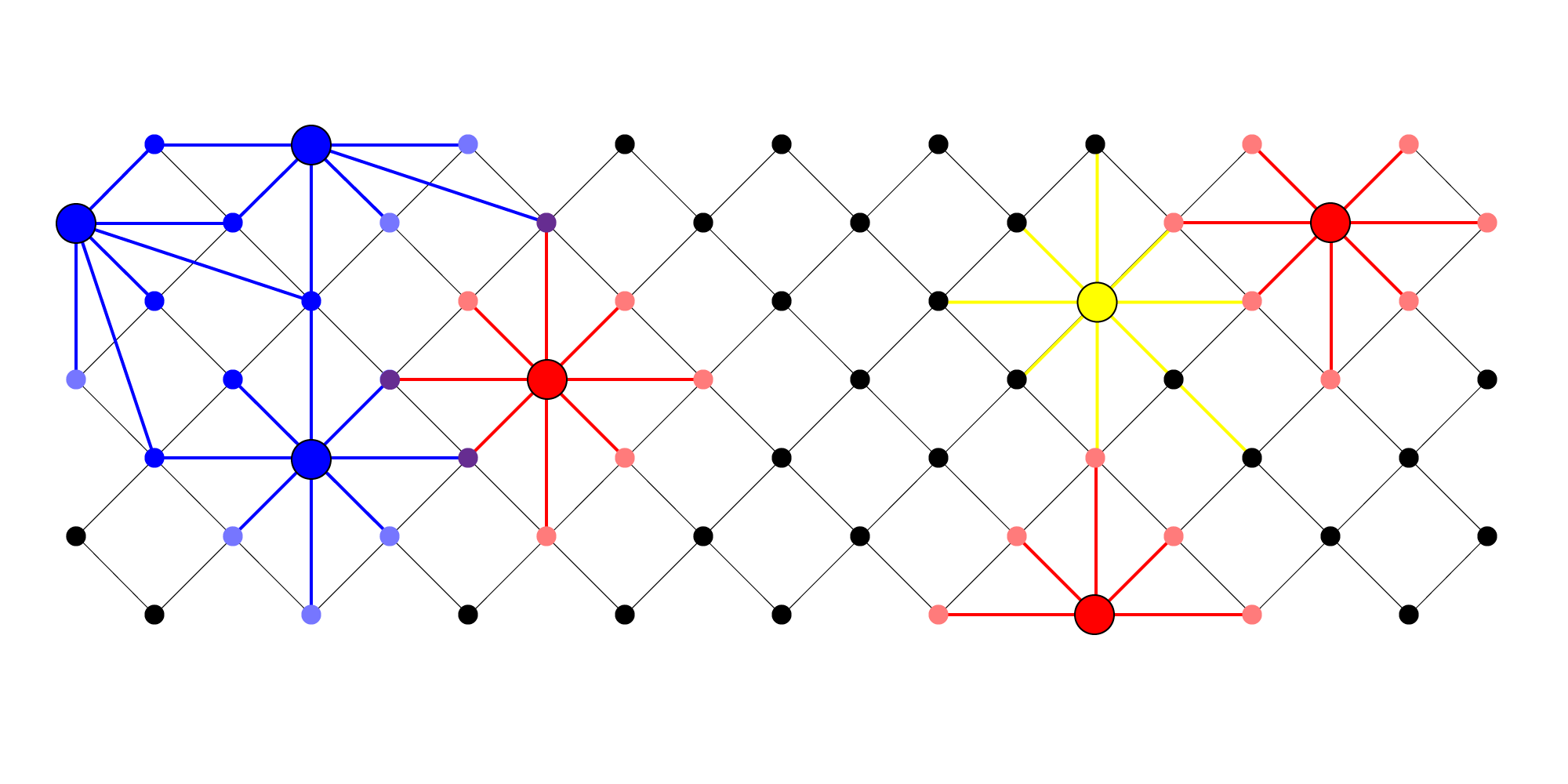
In this context, the yellow evangelist is connected to three individuals that are also connected to red evangelists, which will act as a countervailing influence on those individuals (turning their dots orange):
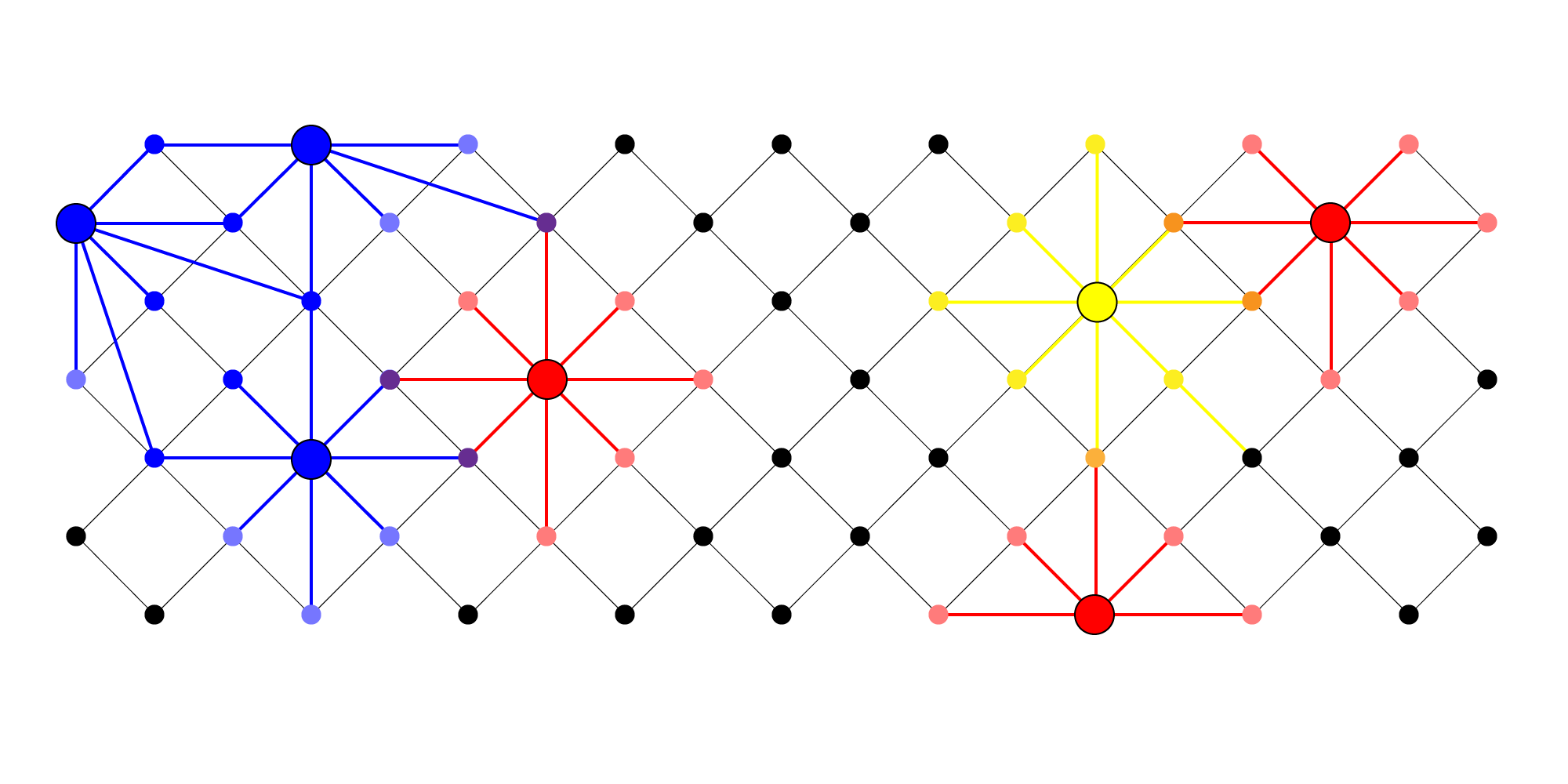
At the end of the day, the blue organization has the best position because its evangelists are in the best position to reinforce each other’s values and viewpoints within their localized sphere of influence. The red organization has just as many evangelists (ie. comparable resources), but because they’re isolated, they don’t have any ability to reinforce each other’s messaging in the network, so their influence is inherently weaker.
It’s made even weaker still by the blue and yellow organizations’ respective evangelists each having shared connections with the red organization’s evangelists, offering contrary messaging to those people.
Again, although Centola never once uses the term in the book, this largely comes down to using peer pressure as a social change strategy — the more people within a given group (social network, local community, corporation, etc.) believe in a particular ideology or adopt a given technology, the “safer” it is for everyone else to jump on board without worrying about their credibility or reputation taking a hit.
Those of us with social change missions can help facilitate this kind of peer pressure by finding evangelists that have decent social standing within their groups and who maintain a large number of shared connections between them. If a few people can influence the people within their shared network via constantly reinforcing effective messaging, then they can create a new community at the periphery of the overall population which has adopted the new viewpoint.
Get a few of those communities together at different parts of the network, building wide bridges between those communities, and you have a good shot at nudging the overall population over the tipping point necessary to see a cascade of social change.
Four Approaches to Social Change
Change offers 4 specific approaches to creating influence within a Fishnet-patterned network.
Shotgun
Silver-Bullet
Snowball
Snowball-Neighborhood
According to Centola, only one (and a half) of these strategies is truly effective at spreading complex-contagions: The Snowball. Quoting from a review of the book by Tom Woodroof, here are the strategies proposed:
Shotgun
“The ‘shotgun’ strategy, based on viral marketing principles of simple contagions. This allocates $1 to 10 individuals, who are selected to be as far apart from each other as possible in order to create maximum exposure. However, since redundancy is rejected in favour of reach, each ‘early adopter’ is surrounded by a sea of non-adopters/countervailing influences. There will be no creation of social reinforcement, legitimacy, credibility, or social currency for adoption, and furthermore even well-incentivised change-agents are not immune to peer pressure to themselves abandon the innovation. Finally, once people have been exposed but declined to adopt (and have seen that nobody else who was aware of it has adopted either), the effort will backfire (as happened with Google+); people notice that the innovation failed, and feel a need to find a justification for why they did not adopt it and would not in the future. For all these reasons, the complex contagion will fail.”
Silver Bullet
“The ‘silver bullet’ is a popular alternative strategy, and concentrates all resources on a single ‘influencer’ – someone who is so well-connected and influential that they can single-handedly initiate a chain reaction that transforms their community’s behaviour. As was discussed earlier, a highly-connected individual faces overwhelming countervailing influences and is therefore unlikely to come out against the status quo. However, if the $10 incentive works, then the influencer will promote the new norm to all of their contacts. Since (by definition) this person has many widely-distributed contacts, this appears to be an even more efficient way to spread it than the shotgun strategy. However, the influencer’s contacts themselves would find themselves in the same position as the shotgun strategy’s change agents, but without even the $1 incentive to protect them against countervailing influences. If the influencer’s contacts are tightly clustered enough to support each other, then this defeats the purpose of using an expensive influencer in the first place. Finally, backfire effects can be even worse than for the shotgun strategy; with Google Glass, high-status ‘influencer’ early adopters violated non-adopters’ social norms so badly that implicit expectations about face-to-face interaction turned into an explicit culture war, stigmatising the technology. In general, any challenging social innovation should prioritise local support over widespread awareness.”
Snowball
“The final strategy is the ‘snowball’. Instead of targeting special people, special places where the innovation can take hold are utilised. Rather than trying to convince everyone to adopt at once, the innovation is carefully incubated as support grows towards a critical mass. Similar to the shotgun strategy, the $10 would be distributed between ten people, but they should be selected from the same social cluster, rather than spread as widely as possible. Their mutual reinforcement allows them to not just stick with the innovation to give it a foothold, but to spread it to neighbouring clusters across wide bridges through coordinating to increase its legitimacy, credibility, and social currency until the tipping point is reached.”
Snowball Neighborhood
This is a variant of the snowball strategy. It’s identical to the above, except that evangelists are chosen based on their geographic location (eg. people living in a single neighborhood), rather than for their personal networks. This strategy was employed in some examples Centola provides, and while it’s less effective than finding out who the key players are in a given social cluster, it’s still pretty effective and can be attempted without the same degree of local knowledge.
The 25% Tipping Point
As we’ve already discussed, in order for a complex contagion such as a major shift in ideology or social norms to spread within a given population, there must be a significant amount of overlap between individuals within a given segment of the population all reinforcing the same ideas. Again: Peer pressure.
But peer pressure only works if there is a perceived majority or at least substantial minority pushing the new values on the group.
In some cases, a smaller, more exclusive group of influencers is all you need (eg. a comparatively small group of “popular kids” at a high school can drive the adoption of new clothing styles or slang phrases), but researchers find that complex contagions are more likely to become widely adopted after they reach a tipping point of about 25% of the group’s members signing on.
Centola’s team ran a series of experiments to confirm this idea. Quoting Woodroof:
“Based on Wittgenstein’s idea that the way people make sense of the world is through a series of coordination games, the tipping point can be defined as the moment at which people could no longer coordinate without changing a norm; in other words, the point at which people’s need for socially-coordinated behaviour overcomes their desire for continuity and tradition.
An experiment using a ‘naming game’ was conducted to answer these questions. People in ten independent groups of twenty to thirty people were connected into a network, within which they had to come up with an appropriate name for a random person. In each round, they were paired with another participant, and received monetary rewards or punishments if they chose the same or different names respectively. People could not use population-level data to inform their choices (they could only see what their current partner had guessed in the last round), and of course there was no right answer. Although there was chaos initially, within fifteen rounds people always converged on an answer. This happened because as soon as two people guessed the same name by chance, they would feel pleasantly surprised and stick with it for at least a few more rounds. When someone encountered both of these players in succession, they would likely start using the same name, as would anyone else with the same contacts. This spark of coordination could then spread throughout the network, being further reinforced with every round. People immediately knew what to expect from a new contact, and since people were rewarded for coordination, there was every incentive to stick with it. Although in each group the name was different, convergence was observed in all cases.
Each group was then seeded with a group of ‘committed activists’, who were tasked with overturning the norm by relentlessly sticking with an alternative name. When these activists made up 17-21% of the population, their efforts over dozens of rounds made no difference. But once they reached 25% or above, the committed minority succeeded every time in abruptly shifting the norm.”
This seems like generally good news to me, because it means that it doesn’t necessarily take a huge number of people to make new ideas acceptable to a larger group as long as you can first target a bunch of small-ish subculture groups and roll that snowball down the hill.
Case Studies
Here, I will also be quoting from Tom Woodroof.
Dustbowl Farmers
“Despite the vast amounts spent in the 1930s developing and marketing it, and the Dustbowl conditions that it was better suited for than conventional varieties, by 1933 fewer than 1% of farmers had adopted it, despite a traditional media and viral marketing campaign that meant almost 70% had heard of it. There were multiple obstacles: expense, fear of the unknown, its odd appearance, and the Dustbowl that made people even more risk-averse than usual. Particularly in tough times, people rely on a reputation for solid decision-making. If they take a bad risk on something that others have already rejected, it makes them look foolish and incompetent. Because these influences fell in farmers’ blind spot, rumours that something must be wrong with the seed began to circulate, justifying non-adoption. Ironically, these rumours spread through the same word-of-mouth channels that the earlier advertisements had targeted, with new evidence circulated to counter the rumours only serving to deepen suspicions.
By 1934, the companies promoting hybrid corn had almost given up. By chance, however, a small group of early-adopters in Iowa formed a ‘community laboratory’ to experiment with the new corn. Once it took hold there, the same factors that caused farmers to initially resist it now caused them to adopt it; they could see the success their peers were having with it, making it seem more credible – social confirmation which reduced the perceived risk of using it, leading to legitimisation. Hybrid corn became an increasingly widespread innovation to help farmers through the drought, and within a decade it had achieved 98% market penetration in Iowa. It then spread across the US, ultimately reaching 100% saturation.”
Renewable Energy in Germany
“The spirit of the snowball can be seen in Germany’s ‘1000 roofs’ strategy, which aimed to redress the gap that existed in 1990 between its ambitious renewable energy goals and the reality of limited adoption. Within a short space of time, the government oversaw the installation of roof-mounted solar on two thousand grid-connected homes. Even though this is a tiny fraction of homes, the selected houses were tightly clustered. A 2016 study reported that in neighbourhoods where a critical mass had been achieved, a dense concentration of adoption had proliferated throughout the entire region and even across state lines and national borders. By this point, Germany had the world’s highest per-capita solar energy production, with the analysis finding that neighbourhood-level social influences were essential for the speed and scale of the transformation. Similarly in Japan, the strongest predictor of whether a household installed rooftop solar was the number of people in their neighbourhood who already had it, as opposed to the financial incentives on offer. These case studies show that the snowball-neighbourhood strategy can be effective, but this depends on two key factors: in addition to the requirement for a sufficient density of early-adopters on a specific street or block to pressure others into coordinating on the new norm, the behaviour also has to be visible.”
Malawi Farmers
“The snowball strategy was demonstrated by a study of adoption of a sustainable farming practice (pit planting) in Malawi. Despite years of government and NGO efforts at outreach and promotion, by 2009 fewer than 1% of Malawi farmers were using pit planting. In 2010, a tipping points strategy was tested by a group of scientists led by economist Lori Beaman. After exhaustively mapping the social connections in 200 villages (each with about 200 people), they worked with the government to train ‘change agents’ for each village. The villages were divided into four groups, and a different strategy was tested on each group of 50: shotgun, snowball, snowball-neighbourhood (in which residential neighbourhoods were used to select change agents, with the hope that this would provide enough reinforcement by chance, i.e. without the expense of producing a full social network map), and silver bullet (which, since this was the outreach strategy already being used by the government, served as the control group).
It quickly became clear that pit planting was a complex contagion, with willingness to even learn about it strongly dependent on social reinforcement (farmers connected to more than one change agent were more than 200% more likely to adopt it than those connected to only one). The study’s conclusions were clear: the government’s silver bullet/influencer strategy had came in last, with almost no impact on knowledge or uptake. The shotgun strategy was only slightly better. Snowball-neighbourhood had a significant impact, with a 50% increase in adoption compared to the shotgun strategy but no meaningful effect on social norms. Snowball was by far the most effective; even with only two change agents (the absolute minimum required), it produced an almost 300% increase in adoption compared to the shotgun strategy, as well as spreading knowledge. The snowball-neighbourhood strategy proved most sensitive to the number of change agents, since selecting more within the same geographic area would increase the odds that they would share social clusters. The snowball strategy was also boosted by extra change agents, whilst shotgun and silver bullet were not.”
The 50-Cent Army
Centola also repeatedly brings up China’s utilization of the “50-cent Army” in order to influence social values and control the narratives that spread online. The gist is that the Chinese government’s Ministry of Culture pays tens of thousands of individuals 50c per post to comment on social networks such as Weibo.
When the abuse and unjust imprisonment of Uyghur Muslims became more widely known by the general public, the 50-cent Army was deployed not to debate people posting about the situation, but to flood social networks with completely unrelated posts. This strategy is Machiavellian and brilliant in an amoral sort of way because it resolves a number of common challenges at once:
Debating critics can often inadvertently elevate the critics’ reach. If you’re afraid that the critics will be more persuasive than you are, refusing to engage directly sucks the air out of the proverbial room and side-steps the risk of promoting the opposition by accident — it’s like the anti-Streisand Effect;
Creating a cloud of disinformation distracts the general public from being able to focus on any one conversational thread, thus burying the criticism;
Since everybody in China knows the government does this, it’s hard to know whether or not the person in your mentions is a citizen expressing their genuinely held opinions, or a government employee promoting propaganda. This destabilizes the entire community’s sense of reality, leaving people uncertain of what’s true or false.
While there’s no evidence that China’s government intended to do this, because it is so extensive, the 50-Cent Army functions just like a Snowball strategy — embedding change agents in community networks close enough to each other that there’s tons of redundancy and overlap in messaging, flooding regular citizens’ feeds with disinformation. This strategy isn’t designed to actually change anyone’s minds, so much as it’s designed to block other potential change agents from getting their messages seen.
Using Networks for Innovation
This is perhaps the most fascinating aspect of Centola’s book to me personally, because he seems to have stumbled on the concept of spontaneous order and the benefits of tacit knowledge in a very Hayekian sense, while — I suspect — not actually being familiar with Hayek at all.
Centola notes that innovation is a process that works best when lots of people are working on solving the same problem, connected by strong ties (ie. “wide bridges”), where everyone within the network is 1) free to pursue their own ideas; and where they are 2) relatively isolated from any high-profile influencer that might prematurely push one solution on the entire group before all ideas were fully explored.
Quoting Woodroof (summarizing Centola’s chapter on innovation):
“As in engineering, innovative successes arise when a team of people with complementary skills come together in a ‘social cluster’. For such teams, what matters most of all is how well connected they are to their larger creative network. The most intense periods of innovation on Broadway have occurred when the network has consisted of social clusters connected by wide bridges. Each cluster could incubate a distinct style, whilst the bridges enabled experienced artists and newcomers to coordinate to explore new ideas. In contrast, firework display networks (where everyone works with everyone, and a few people and themes dominate) have historically produced very high rates of flops. As with the initial failure to introduce hybrid corn, the status quo had a reasonable track record and was firmly entrenched, with innovators facing overwhelming countervailing influences, forcing them to conform.
Applying this to small-scale teams challenges the conventional management wisdom around optimising for informational flows through weak ties, weekly meetings, regular check-ins, and high-contact spaces. The intention is that everyone is kept in the loop on the latest breakthroughs at all times. These strategies may work for solving simple problems, but not for complex ones.
This is illustrated by research on the 2006 Netflix Prize, a competition to find the best film predictor algorithm, and subsequent public competitions for solving difficult problems. By designing different team network structures, different approaches to innovation management were tested. In the eight fireworks network teams, everyone was connected to everyone to optimise for immediate sharing of discoveries. In the eight fishing net teams, however, members could only see solutions produced by the few people they were immediately connected to, with solutions originating further away required to travel across wide bridges to get to them.
In a data set with more than 15 000 possible solutions, the fireworks teams started off well, with ‘good’ solutions reaching everyone almost as soon as they were found. The teams then coalesced on these solutions and continued to improve them, but at the expense of wider exploration of the solution landscape. By all looking at the problem in the same way, they missed out on the chance to find the best solutions. In contrast, the clustered teams preserved a diversity of approaches by limiting the spread of information, protecting researchers long enough to do truly innovative things. The result was that each and every fishing net team found a solution that was better than the best one produced by any of the fireworks teams.
This can be explained by observing that familiar solutions are easy to understand and spread, and therefore behave as simple contagions that – in a fireworks network – easily outcompete unfamiliar ideas that must spread in a complex manner.
When AI algorithms were applied to the same problem, they outperformed the fireworks human teams, but typically not the fishing net teams. They had the same problem as the fireworks teams of failing to find globally optimum solutions by prematurely latching onto single, strongly-predictive variables at the expense of exploring more unusual combinations.
This demonstrates that well-designed teams are characterised by coordination across diversity of approach. This enables them to both explore unusual ideas and reinforce promising innovations, something that – for complex problems – is not best supported by maximising information flow.
Another illustration of this is the apparent paradox that although China was far ahead of Europe in developing and spreading innovations for most of history, it was relatively backward European states which ended up dominating much of the world. However, China had a highly centralised pattern of informational and political networks, which – although they enabled innovations to spread extremely rapidly at first, and gave China a head start – also resulted in a long-term tendency to stamp on radical changes. By contrast, Europe was a patchwork of comparatively small states, much more like a fishing net. Innovations were frequently impeded by national borders, which – although slowing down development – also enabled unique cultures and approaches to develop. In the long run, European states were able to invent – and adapt from outside sources, such as China – things that the others could not have imagined, and that the Chinese state would not have allowed.”
In other words, the “Fireworks” network — where there is one extremely influential person (or AI) at the center of a hub of people who are not otherwise well connected to each other — is the worst way to innovate, while the “Fishnet” network is usually the best, particularly if the members of that network aren’t pressured to approach the problem in a singular way.
“Within political echo chambers, highly connected influencers at the center of the conversation can easily spread misinformation (“simple contagions”) that plays to a group’s biases”
— Damon Centola
Ironically, Centola also spends a good amount of the book talking about Covid and the government’s attempts to get people to participate in their recommended public health interventions (masks, vaccinations, etc.), and he doesn’t once seem to acknowledge that every bit of Covid-era public policy was determined by a “Fireworks” network with Fauci and a very small team at the center which had the direct power to immediately suppress other ideas before they ever had a chance to germinate.
In general, one of my bigger criticisms of Centola’s book is that it always seems to give the benefit of the doubt to governments (except China) that the things they’re trying to manipulate their citizens into believing and doing are noble and good (eg. Germany’s solar adoption push, which in hindsight resulted in massive spikes in energy costs, power outages, and increased deaths from cold for people who could no longer afford to heat their homes).
Centola’s Seven Strategies
The final chapter of the book summarizes everything and offers 7 strategies for effective change, as follows:
“Don’t rely on contagiousness — significant changes do not spread like a virus
Protect the innovators – innovations that face entrenched opposition can work if the innovators have less exposure to the entire network. Target the clusters in the network periphery, where they can reinforce one another without being overwhelmed by countervailing influencers.
Use the network periphery – influencers can be a roadblock to change, being connected to large numbers of people conforming to the status quo. People in the periphery are less connected, and therefore less likely to be stopped by countervailing influences.
Establish wide bridges – redundancy is required between groups to establish trust, credibility, and legitimacy. This is the concept of wide bridges and facilitates behaviour change shifting from one group to another.
Create relevance – this relies on understanding the change: if proof is required, then similarities between adopters are key; if excitement needs to be generated, then similarity is again key; when legitimacy is required and the behaviour needs to be widely accepted, then diversity among groups is required.
Use the snowball strategy – target those special places in the network where you can create small pockets of legitimacy, where the early adopters can reinforce one another. To be effective, you firstly need to understand the network, and secondly also target groups which can bridge to other groups.
Design team networks to improve discovery and reduce bias – it is vital protect the innovators and early adopters from influences that reinforce the status quo.”
How Marketers and Educators Can Use This Information
Personally, I didn’t find a lot of Change to be groundbreaking, but that’s mainly because it aligns very well within my experience and information I’ve previously seen from other sources.
The biggest takeaway that I think anybody looking to persuade others should pay attention to is the idea that to effectively spread a “complex contagion” such as the values of a free society to the masses, our industry needs to do a much better job of the following:
Relevance: We need to be mass-producing messaging that appeals to specific communities;
Credibility: We need to convince the most influential members of those communities to promote those messages within their networks;
Redundancy: Those local influencers should be interacting with the same people over and over again, frequently reinforcing those messages;
Build Bridges: We need those local influencers to connect with each other, creating wide bridges from one community or “neighborhood” to another, eventually tying everyone together into one more cohesive community.
This can (and probably must) start small, converting a few niche networks into pro-freedom communities first, then ensuring that those communities get to know each other. The more niche communities we convert, the easier it will become to convert new ones.
This isn’t all that different from my approach at FEE, which was to try to create a bunch of different products that were targeted to different groups of people, and then hopefully get those groups to connect to each other via the FEE website, webinars, and FEEcon.
This isn’t quite what Centola recommends, though, as he’s really talking much more about grassroots / direct connections, but I think the principles are the same as long as we’re not just relying on the content creator “influencer” to change the world. Instead, we need to rely on content creators to develop a large Fireworks network and as quickly as possible try to convert subscribers into community-members who actually know each other — perhaps via online groups — and once there’s a Fishnet network built among fans of the series, we should find ways to encourage those people to reinforce messages within the group and outside of it..
From there, we need to find ways of connecting one community to another over some “wide bridges”.
Alternatively (or additionally), we should be helping our clients figure out ways to form a better network of influence by connecting wider bridges from one organization to another. Not sure to what degree this is possible. The communities we’re trying to influence need the same message reinforced by a lot of different sources simultaneously, particularly from people who they trust.